How to Start Forex Trading as a Beginner With a Systematic Market-Based Approach
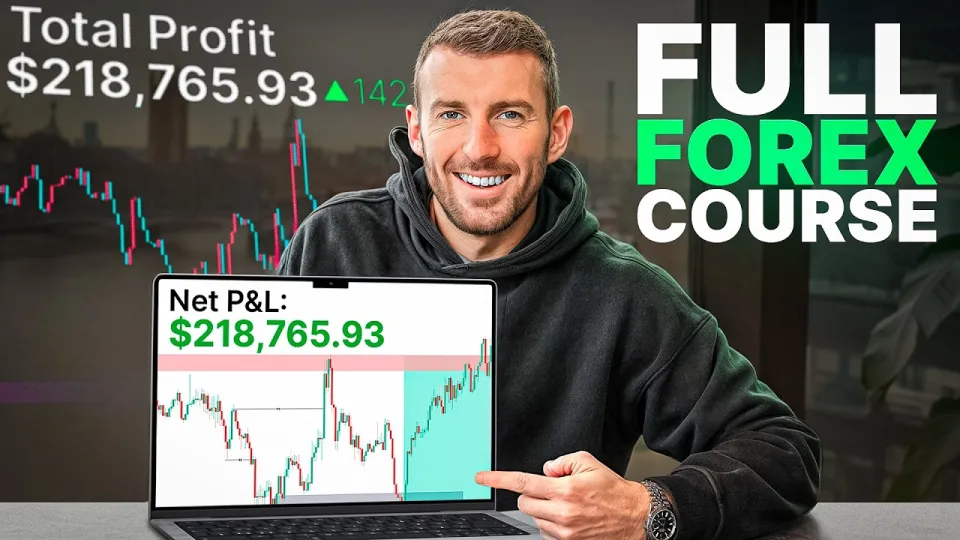
Video: Beginners Guide To Forex Trading In 2026 (+3 hours)
You can order the same kind of articles for your own video to boost it on YouTube and Google. Just message the Telegram bot @sat_sit_bot. The bot writes and publishes the articles itself (with your YouTube video embedded) on popular topical websites (no ads). Try it free: 50 articles on us.
· based on the channel Matt Donlevey - Photon Trading
Key takeaways
- Forex is the market where currencies are quoted in pairs, such as EUR/USD, and the spread between bid and ask is your first built-in cost.
- Technical analysis alone does not explain price movement; market microstructure, the orderbook, auction market theory and orderflow are the underlying mechanics.
- A complete beginner path covers market structure, three structure types, premium and discount zones, multi-timeframe analysis, supply and demand and liquidity.
- Risk management, a written trade plan, backtesting, a broker choice, trading costs and journaling are treated as part of the strategy, not afterthoughts.
- Matt Donlevey - Photon Trading published a free three-hour beginner guide and offers a free course with cheatsheets via photontradingfx.com.
Forex trading for beginners works best as a sequence: understand what the currency market is, learn how price actually moves through market microstructure and orderflow, then build a rule-based strategy with entries, risk limits, a written trade plan and a journal. A free structured starting point is the Photon Trading free course and cheatsheets, which accompanies the channel's beginner material.
What forex trading actually is and how much capital it requires
Forex is the over-the-counter market where national currencies are exchanged in pairs, and every quote has two sides: the bid you can sell at and the ask you can buy at, with the spread between them as a cost you pay on entry. Unlike a stock exchange, there is no single central venue; trading is distributed across banks, brokers and liquidity providers, which is why the mechanics of the orderbook matter more than any geometric pattern on a chart.
Beginners usually ask two practical questions first: how much money can be made and how much is needed to start. Honest answers depend on three variables rather than a fixed number:
- Account size and the risk per trade, typically expressed as a small percentage of equity.
- The edge — the statistical difference between your wins and losses over a large sample of trades.
- Costs: spread, commissions, swap or financing charges, and slippage.
A strategy with a modest edge and tight risk control can compound steadily; the same strategy with oversized positions can erase an account in a handful of trades. Treat any income projection as a function of tested expectancy, not as a target to chase.
Why technical analysis fails without market dynamics
Technical analysis has a poor reputation because shapes on a chart do not explain why price moves; the explanation lives in the interaction of resting orders, liquidity and the auction process. Candlesticks are only a compression of the underlying activity, so reading them without the mechanics behind them is guesswork.
Three concepts do the heavy lifting:
- Market microstructure — bid, ask and spread define the immediate cost and the direction of aggression.
- Orderbook and orderflow — visible and hidden resting orders show where liquidity sits and where stops are likely clustered.
- Auction market theory — price moves to find areas where buyers and sellers agree on value, and it accelerates through zones where one side is thin.
Once those dynamics are understood, chart reading becomes a way to locate where other participants are trapped or where liquidity is likely to be taken, rather than a search for triangles and flags.
The core concepts of a systematic forex strategy
A systematic strategy is built from a small set of repeatable concepts that are defined in advance, so that every decision can be tested and reviewed later. The beginner curriculum that follows from market dynamics includes the following building blocks.
- Market structure — the sequence of higher highs and higher lows or lower highs and lower lows that defines directional bias.
- Three types of structure — internal, external and the shift that signals a change in control; distinguishing them prevents trading counter to the dominant flow.
- Premium and discount — dividing a range into halves so that buys are taken at a discount and sells at a premium, improving the risk-to-reward ratio.
- Multi-timeframe analysis — using a higher timeframe for bias and a lower one for execution, so that entries align with the larger auction.
- Supply and demand — identifying zones where aggressive orders previously overwhelmed the opposite side and where unfilled interest may remain.
- Liquidity concepts — locating clusters of stops and pending orders that price is drawn toward before continuing.
Each concept is a filter, not a signal. The strategy only fires when several of them agree, which is what separates a rule-based process from discretionary chart browsing.
Entries, trade management and money management rules
Execution is the part beginners rush, yet it is where a good idea is either preserved or destroyed. Entries should be defined by a trigger you can describe in one sentence, such as a reaction from a demand zone at a discount after a liquidity sweep, with a stop placed beyond the level that would invalidate the idea.
Trade management covers what happens after entry: partial exits, moving to breakeven, trailing and time-based exits. Money management sets position size from the distance to the stop and a fixed risk per trade, so that a losing streak of several trades remains survivable. Position sizing is arithmetic, not intuition: if risk per trade and stop distance are known, the lot size is determined, not chosen.
Three mistakes recur among beginners and are worth naming explicitly:
- Oversizing positions after a win or a loss.
- Moving or removing a stop to avoid taking a loss.
- Switching strategies after a handful of losing trades instead of evaluating a statistically meaningful sample.
Building a trade plan, backtesting and choosing a broker
A trade plan is a written document that states which markets you trade, which sessions, which setups, what risk per trade, what daily loss limit applies and what conditions stop you for the day. Without it, every decision becomes a fresh negotiation with yourself, and consistency becomes impossible to measure.
Backtesting turns the plan into evidence. A simple process works: define the setup precisely, go through historical charts, log every qualifying trade including the losers, and compute win rate, average risk-to-reward and expectancy. Forward testing on a demo account then checks whether execution matches the plan.
Broker selection and costs belong in the same conversation:
- Regulation and segregation of client funds.
- Spreads and commissions on the pairs you actually trade.
- Execution quality and slippage around news.
- Financing or swap charges on positions held overnight.
- Platform, order types and the practical process of placing a trade.
Trade journaling closes the loop. Recording the setup, the reason for entry, the outcome and the emotional state turns experience into data, and data is what improves a strategy.
Common beginner questions about learning forex
Beginners often arrive with the same doubts, and most of them come down to sequencing. One recurring theme is pace: a long, dense course can feel overwhelming, so it helps to split it into topics and rewatch one section at a time rather than trying to absorb everything in a single sitting. Another is psychology — many traders try to fix discipline before they have a tested edge, when the more useful order is to build and validate the strategy first and then work on execution under pressure.
A third is cost and access: viewers reasonably ask whether material of this depth is really free, and whether a paid mentorship is required. The core beginner material is available without payment, which makes it a sensible first pass before committing money to anything. Finally, some learners question whether a structured approach is worth the effort compared with following signals; the answer is that a tested process is the only thing that transfers across market conditions.
Useful links
- Free Photon Trading course and cheatsheets: https://www.photontradingfx.com/free-training?el=beginnersguide&htrafficsource=YT
- Photon Trading mentorship: https://www.photontradingfx.com?el=beginnersguide&htrafficsource=yt
- Free Telegram channel with analysis and trade recaps: https://t.me/photontrading
- Instagram: https://www.instagram.com/photontrading/
Final thoughts on learning forex the systematic way
Forex rewards structure rather than enthusiasm: a beginner who understands bid, ask and spread, who reads market structure and liquidity instead of shapes, and who sizes positions from a fixed risk per trade is already ahead of most retail participants. The path is sequential — market dynamics first, then strategy, then backtesting, then a written plan, then journaling and psychology. The three-hour beginner guide by Matt Donlevey - Photon Trading covers exactly that sequence and is a practical reference to work through topic by topic, with the free course and cheatsheets as the accompanying starting point.
Questions & answers
How much money do I need to start forex trading?
There is no fixed minimum, but the account must be large enough that a normal losing streak at your risk per trade does not threaten it. Many beginners start on a demo account and move to a small live account only after their plan has been backtested and forward tested. Costs such as spread and commissions matter more on small accounts.
Is technical analysis useless in forex?
No, but it is incomplete on its own. Candlestick and chart patterns describe what price did, not why it moved; the explanation comes from market microstructure, orderflow and auction market theory. Patterns work better as a way to locate liquidity and imbalance than as standalone signals.
Should I learn trading psychology before or after building a strategy?
Build and test the strategy first, because discipline only has something to protect once a repeatable edge exists. After backtesting and forward testing give you confidence in the rules, psychology work focuses on executing those rules under real pressure. Trying to fix emotions without a tested plan usually leads to switching strategies.
Is a free forex course enough to start, or do I need a paid mentorship?
A free, structured course covering market dynamics, strategy, risk and a trade plan is enough to build a first tested approach. Paid mentorship becomes relevant when you want feedback on execution or accountability. Start with the free material and only pay once you know which specific gap you need filled.
Source: Beginners Guide To Forex Trading In 2026 (+3 hours) · Markdown version